
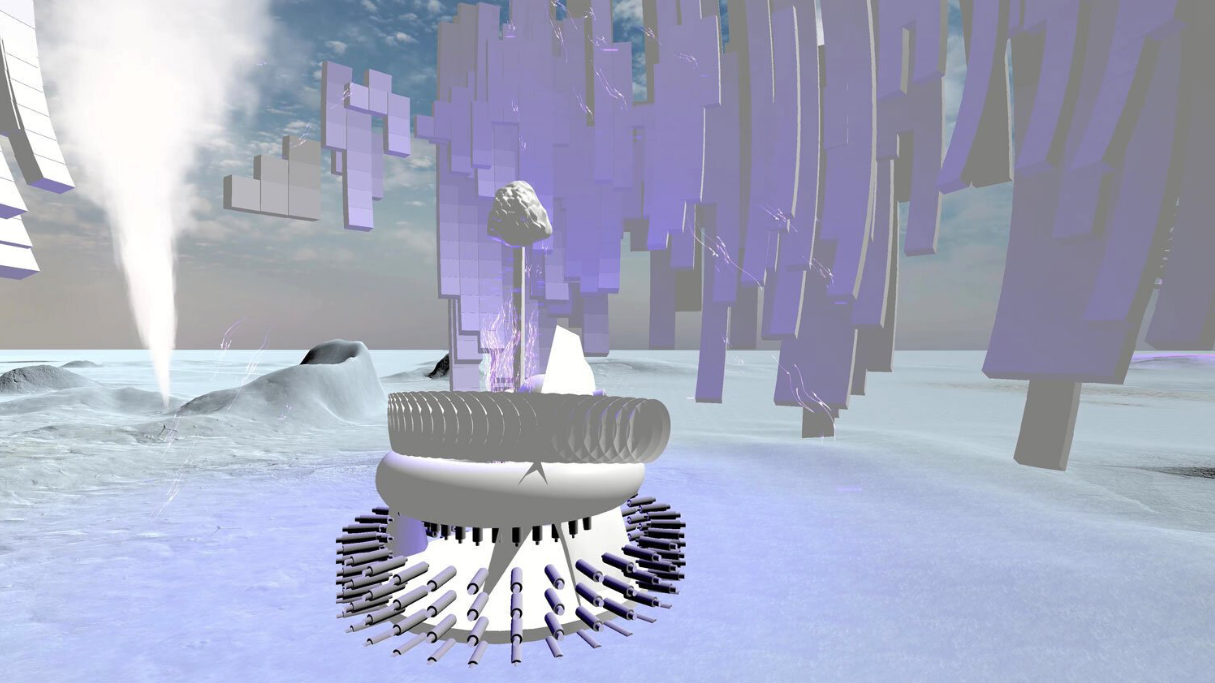
AVANTGARDEN SPHERE 3
Virtual reality art installation / video work, Media Art Sculpture, 2020.
AVANTGARDEN SPHERE 3
SECTOR A
Virtual reality art installation / video work, 2020.
3D graphics, world building, digital sculptures: Tanja Vujinović
Sound: LUZ1E and Mihajlo Đorović
3D models of asteroids (Eros, Geographos, Golevka, Mithra): Nasa
ISLAND
Media Art Sculpture (Sand, plasma-treated water, electronics, plexiglass, metals, 3D prints, LED lights, titanium substrate plates), 2020.
3D modelling: Tanja Vujinović
Objects hardware, assembly: Jože Zajec, ScenArt
3D printing: Tomo Per, RogLab
Hardware device development: Dr Luka Suhadolnik, Department for Nanostructured Materials, Jožef Stefan Institute
Programming and custom-made electronics: Dr Vid Podpečan, Department of Knowledge Technologies, Institute Jozef Stefan
Photographic documentation: Ultramono, Sunčan Patrick Stone, Miha Fras
PLASMONIKA
Virtual reality art installation / video work and media art sculpture (plastic, 3D printed objects, custom-made electronics, LED lights, plexiglass, plasma-treated water, metal), 2020.
Installation was commissioned by Finetuned Limited (curator Julian Weaver) and EUROfusion
3D graphics, world building, digital sculptures: Tanja Vujinović
Sound: LUZ1E and Mihajlo Đorović
PLASMA SECTOR
Virtual reality art installation / video work, 2020.
3D graphics, world building, digital sculptures: Tanja Vujinović
Sound: LUZ1E and Mihajlo Đorović
Executive production: Tanja Vujinović, Jan Kušej
Coproduction: SciArtLab, Institute Jozef Stefan
Production: Tanja Vujinović / Ultramono
Consulting
Jan Kušej, Ultramono Institute
Dr Jelena Guga, researcher
Nataša Todorović, Astronomic Observatory Belgrade
Dr Lowell Morgan, Physicist, Kinema Research
Dr Vid Podpečan, Department of Knowledge Technologies, Institute Jozef Stefan
Tomo Per, RogLab
Jože Zajec, ScenArt
Dr Luka Suhadolnik, Department of Nanostructured materials, Jožef Stefan Institute
Arijana Filipić, Department of Biotechnology and Systems Biology, National Institute of Biology
Derek Snyder, researcher and editor
Julian Weaver, artist and curator, Finetuned Limited
Dr Gregor Primc, Department of Surface Engineering, Jožef Stefan Institute
Dr Rok Zaplotnik, Department of Surface Engineering, Jožef Stefan Institute
Dr Zoran Lj. Petrović, SANU & Institute of Physics, University of Belgrade
Dr Saša Novak, Department of Nanostructured materials, Jožef Stefan Institute
SPHERE 3 is a large-scale virtual world built in Unity and experienced as a single-user VR environment.
The world consists of three connected environments: SECTOR A, ISLAND, and PLASMONIKA.
SECTOR A consists of a virtual landscape containing reactors, collectors, synthetic plants, capsules, asteroids, fountains and energy systems.
Energy collection systems, fluid circulation systems and transport-like capsules are placed throughout the environment.
Four asteroid objects are present in the space.
Photogrammetry fragments are used as surface elements across parts of the environment.
ISLAND is a physical installation consisting of a fountain structure, synthetic plants, titanium-coated surfaces and sound components.
One plant object processes recorded voice input and outputs a generated mono signal.
The fountain circulates chemically treated water within a closed system.
Sound responds to movement and interaction within the space.
PLASMONIKA is a sculptural object functioning as an energy system within the SPHERE 3 framework.
The structure references plasma circulation and energy flow systems.
PLASMA SECTOR consists of a virtual environment populated by interstellar cloud structures, meteor-like objects and non-carbon based forms.
White hole-like structures, quantum loop forms and floating particulate systems are present in the space.
Across SPHERE 3, systems of water, plasma, energy and transport are distributed across virtual and physical environments.
Sector A, Virtual reality art installation, 2020.


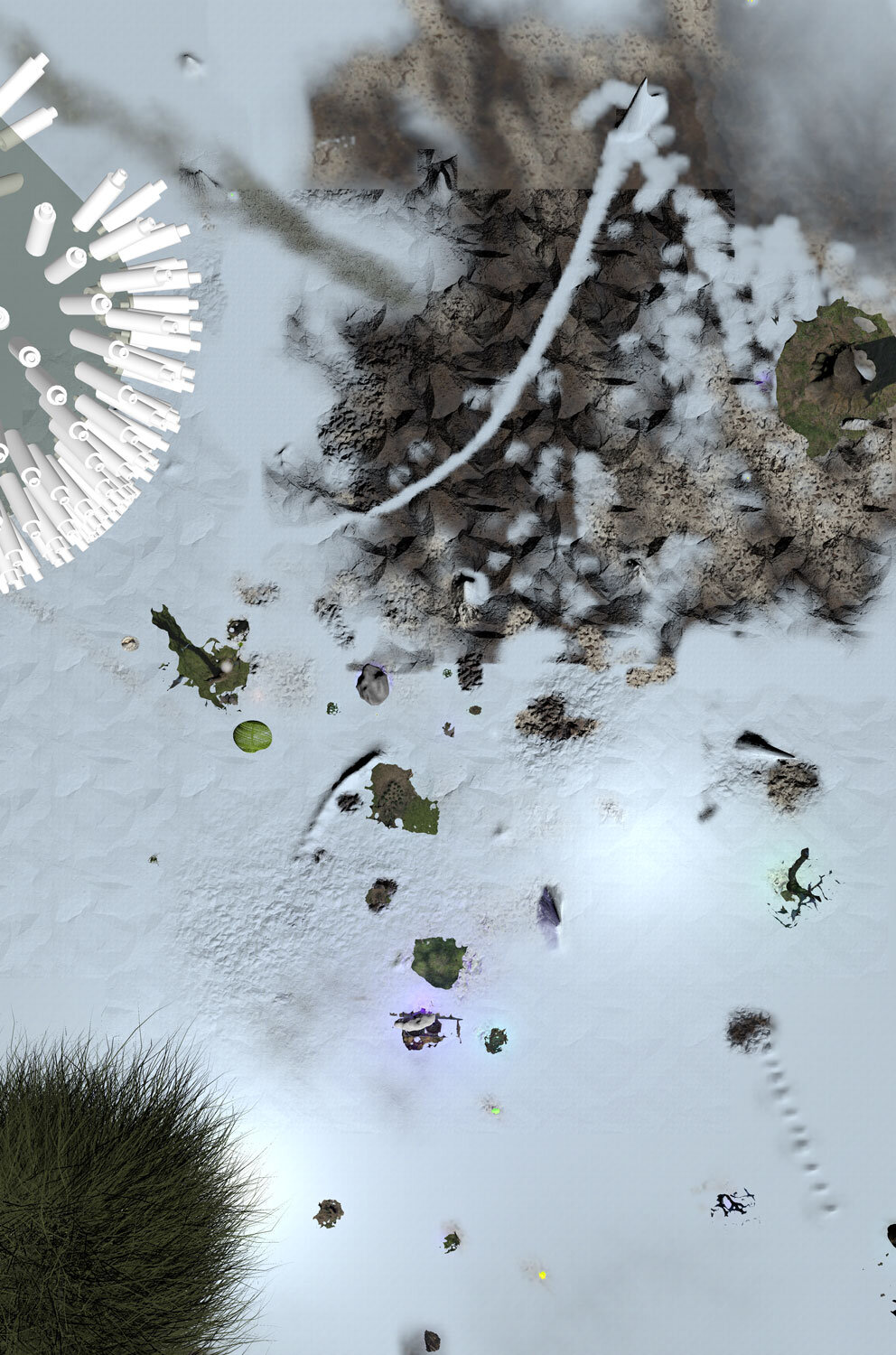


Island, Media art sculpture, 2020.


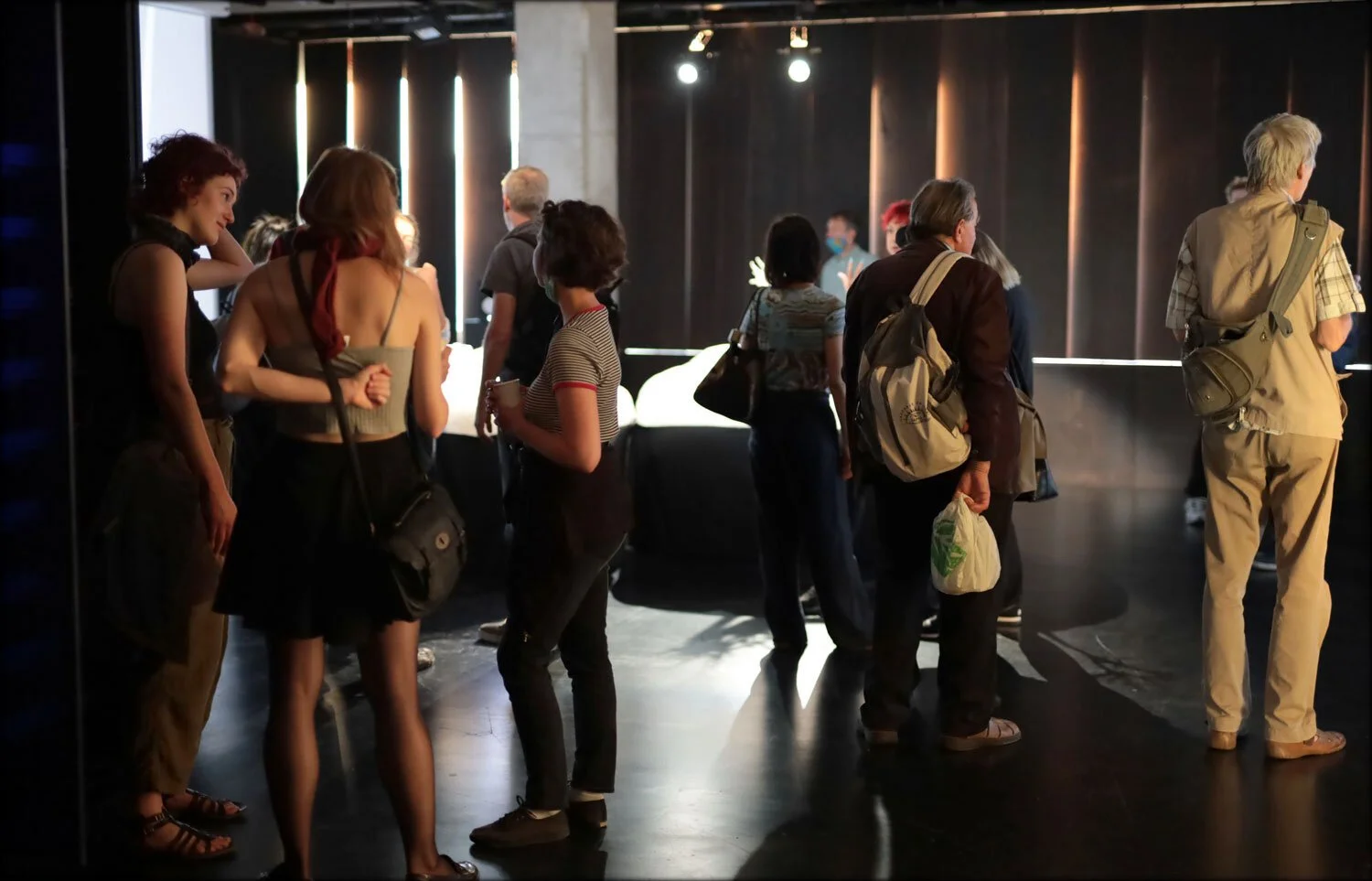

Plasmonika, Virtual reality art installation and Media art sculpture, 2020.


Plasma sector, Virtual reality art installation, 2020.


SPHERE 3 References
“Europlanet Animations – Europlanet Society.” Accessed March 29, 2020. https://www.europlanet-society.org/outreach/europlanet-animations/.
“Nenavaden prizor: na Dolenjskem v objektiv ujeli flaminga.” 24 ur, Slovenija, Accessed March 29, 2020. https://www.24ur.com/novice/slovenija/nenavaden-prizor-na-dolenjskem-v-objektiv-ujeli-flaminga.html.
“TA1 Planetary Field Analogues (PFA) – Europlanet Society.” Accessed March 29, 2020. https://www.europlanet-society.org/europlanet-2024-ri/ta1-pfa/.*
Bailey, Lee Worth. 2005. The Enchantments of Technology. University of Illinois Press.
Benyus, Janine M. Biomimicry Innovation Inspired by Nature. HarperCollins, 1997.
Chorus Radio Waves within Earth's Atmosphere, Courtesty of Electric and Magnetic Field Instrument Suite and Integrated Science (EMFISIS) team at the University of Iowa, Nasa, ttps://www.nasa.gov/connect/sounds/index.html, Accessed March 29, 2020.
Evan Gough, Today Universe. “This Epic Ion Engine Will Power NASA’s Test Mission to Redirect an Asteroid.” ScienceAlert. Accessed March 29, 2020. https://www.sciencealert.com/this-epic-ion-engine-will-power-nasa-s-test-mission-to-redirect-an-asteroid.
Hanneke Weitering. “Giant ‘potentially Hazardous’ Asteroid Will Fly Safely by Earth in April.” livescience.com. Accessed March 29, 2020. https://www.space.com/asteroid-1998-or2-earth-flyby-april-2020.html.
Hester, Jessica Leigh. “Which Houseplants Should We Bring to Space?” Atlas Obscura, 24:00 400AD. http://www.atlasobscura.com/articles/houseplants-grow-in-space.
ITER. “Cooling Water.” Accessed March 29, 2020. http://www.iter.org/mach/coolingwater.
ITER. “Fuelling the Fusion Reaction.” Accessed March 29, 2020. http://www.iter.org/sci/fusionfuels.
MasterClass. “MasterClass | Chris Hadfield Teaches Space Exploration.” Accessed March 29, 2020. https://www.masterclass.com/classes/chris-hadfield-teaches-space-exploration.
Nasa. “Models | 3D Resources.” Accessed March 29, 2020. https://nasa3d.arc.nasa.gov/models.
Nuclear Fusion: Revolutionary New Breakthrough. Accessed March 29, 2020. https://www.youtube.com/watch?v=OlGzt9ur1bY.
ScienceDaily. “What Do We Need to Know to Mine an Asteroid?” Accessed March 22, 2020. https://www.sciencedaily.com/releases/2017/09/170919092612.htm. .
Todorović, Nataša. Asteroidi Mali Kameni Svetovi. Beograd: Astronomska opservatorija Gradska opština Zvezdara, 2019.
Wilson, Jim. “Nasa Audio.” Text. NASA, January 26, 2015. http://www.nasa.gov/connect/sounds/index.html.
Zaleski, Andrew. “Luxembourg Leads the Trillion-Dollar Race to Become the Silicon Valley of Asteroid Mining.” CNBC, April 16, 2018. https://www.cnbc.com/2018/04/16/luxembourg-vies-to-become-the-silicon-valley-of-asteroid-mining.html.